
Your body doesn't speak in numbers.
It speaks in sensations. Hunger. Fatigue. Clarity. Restlessness. Pain.
These are signals, not data points. They're your body's native language for communicating state.
But somewhere along the way, health technology decided the interface should be different. Not sensations translated and clarified, but sensations replaced with metrics.
Heart rate variability. Sleep scores. Readiness percentages. Glucose curves.
The assumption was: if you see the numbers, you'll understand your body better.
That didn't happen.
Instead, we ended up with two disconnected languages. What your body feels versus what your devices measure. And most people can't translate between them.
The interface problem
An interface is a translation layer. It takes complex system states and makes them actionable.
Your car's dashboard doesn't show you raw engine data. It shows you: fuel level, speed, temperature warnings. The minimal information needed to drive safely.
Your phone doesn't expose system processes. It shows you: battery life, signal strength, storage space. Just enough to make decisions.
Health tech went the opposite direction. It exposed everything and translated nothing.
The result? People drowning in data they can't use.
What forecasting actually does
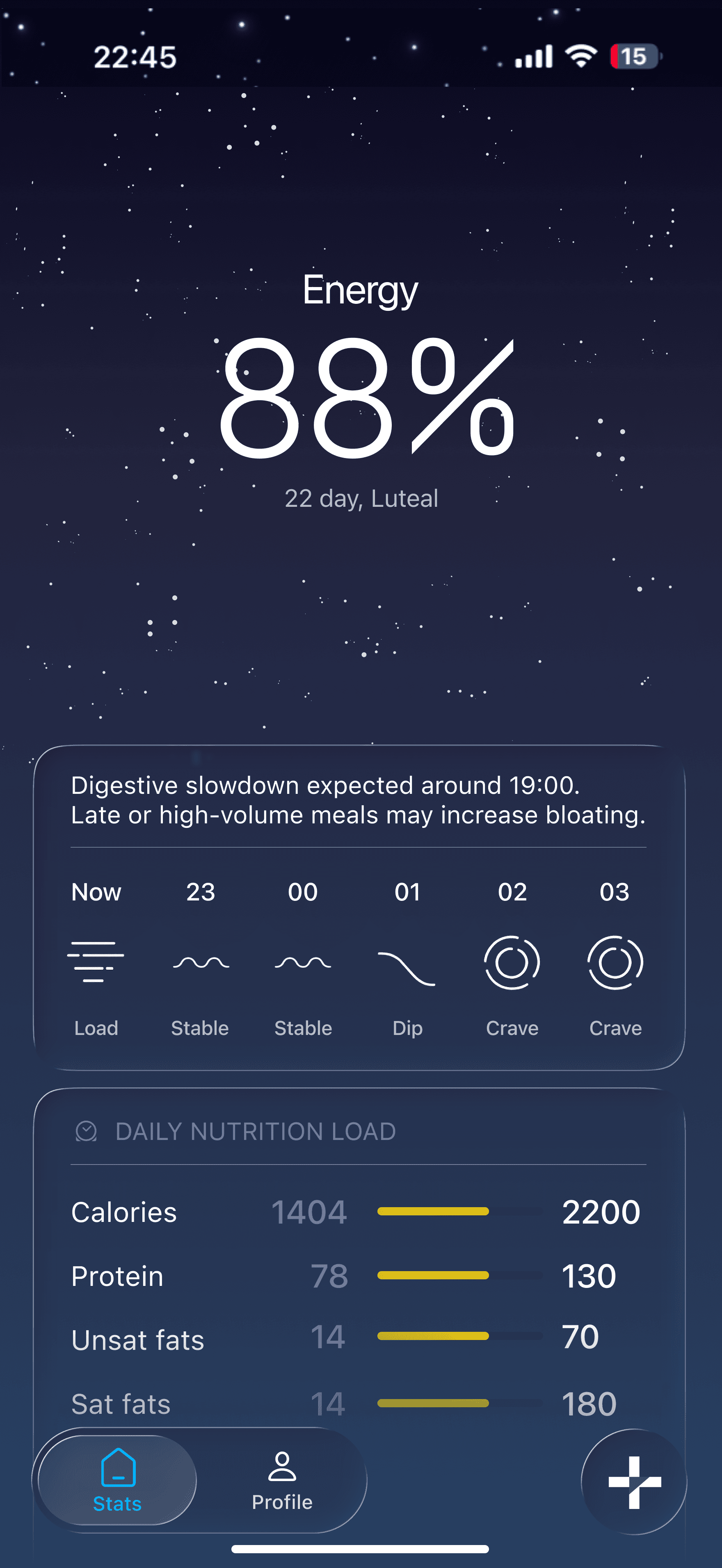
Biological forecasting isn't about predicting the future. It's about building a new interface.
Instead of showing you what happened (tracking) or what's happening now (monitoring), forecasting asks: what does this current state mean for the next decision you need to make?
This is fundamentally different.
Your wearable says: "HRV dropped 15% overnight."
A forecasting interface should say: "Your body is showing early stress accumulation. High-intensity work today will likely compound this. Consider postponing the hard session until tomorrow when recovery markers should normalize."
One is a measurement. The other is a decision
Anticipatory vs reactive
Current health interfaces are quite reactive. They respond to questions you ask.
"What was my sleep score?" "How many steps did I take?" "What's my glucose right now?"
Forecasting interfaces are anticipatory. They surface information before you need it.
You're planning lunch. Before you even think to check, the interface shows: "Your insulin sensitivity is currently low due to sleep debt and morning cortisol elevation. High-carb meals right now will likely cause afternoon energy crashes. This should normalize by dinner."
You didn't ask. The system anticipated the decision moment and provided context.
That's the shift I am talking about. From responsive to anticipatory.
The translation layer
Here's what forecasting actually does technically: it translates biological signals into decision-relevant states.
Raw signals:
HRV: 42ms
Resting heart rate: 58 bpm
Sleep duration: 6.2 hours
Movement: 4,200 steps
Glucose: 95 mg/dL
Translated state would as somlthing like that: "Recovery capacity is at 60% of baseline. You can handle moderate cognitive load today, tho sustained high-intensity work will accumulate deficit… Physical performance is available but recovery cost will be elevated"
Context-aware, not context-free
Traditional metrics are context-free. They show values without interpretation.
Glucose: 120 mg/dL
Is that good? Bad? Depends entirely on context:
After a meal? Normal.
Fasting? Concerning.
Post-workout? Expected.
During sleep? Worth investigating.
Forecasting interfaces are context-aware by design.
They don't just show the value. They interpret it against:
Your individual baseline
Time of day
Recent activity
Current metabolic state
Historical patterns
Then they answer the actual question: what does this mean for what I'm about to do?
State representation over time
The key technical shift is from snapshots to sort of trajectories. So current interfaces show you where you are: "Sleep score: 73."
Forecasting interfaces show you where you're going: "You're entering a recovery deficit. Continue current sleep pattern for two more nights and cognitive performance will degrade 20-25%. Full restoration requires three consecutive nights of 8+ hours."
This is state representation over time
It's the difference between a thermometer (shows current temperature) and a thermostat (shows current temperature and regulates future state).
The uncertainty question
Here's what makes this hard: biology is probabilistic, not deterministic.
You can't say "if you do X, Y will definitely happen"
You can say "if you do X, Y will probably happen, with Z confidence"
We believe, good forecasting interfaces communicate uncertainty honestly:
"Based on your current state, this meal will likely cause a glucose spike. Confidence: high (we've seen this pattern 8 out of 10 times in similar contexts)."
or
"Your readiness for high-intensity training is uncertain. Sleep was poor, but training response has been variable lately. Suggest starting moderate and adjusting based on feel."
Admitting uncertainty is not a weakness. It's kinda what makes the interface trustworthy in my eyes.
Adaptive, not static
Static interfaces show the same information regardless of state.
Your dashboard always shows: steps, sleep, heart rate, calories.
We are exploring the option for Forecasting interfaces to adapt to what matters right now.
If you're entering sleep debt → sleep-related forecasts move to the foreground.
If training load is accumulating → recovery projections become primary.
If stress markers are elevated → stress-sensitive decisions get context.
The interface reorganizes around current biological priorities, eleminating the fixed categories.
So we move from monitoring to navigation
Navigation tells you: given where you are and where you're trying to go, here's the route that works with current conditions.
You don't need to see all the traffic data, road conditions, and weather patterns. You need to know: turn left in 500 meters, faster route available, construction ahead.
Biological forecasting shall do this for health decisions.
Not "here's all your data" but "here's what matters for your next choice."
Interestingly, we already understand this interface in other domains.
Weather apps don't just show temperature and humidity. They forecast: "Rain likely in 2 hours. Temperature dropping this evening."
Some financial apps don't just show only account balances. They project: "At current spending, you'll hit your limit in 8 days."
These are all forecasting interfaces. They translate system state into decision guidance.
Health is one of the last domains that are still stuck in raw measurement mode.
What changes
When biological forecasting works, the experience shifts:
You stop asking "what happened?" and start asking "what should I do?"
You stop checking scores and start getting guidance at decision moments.
You stop translating data yourself and start trusting the translation layer.
You stop managing your body through metrics and start navigating it through forecasts.
The body is still the same. The biology hasn't changed.
But the interface between you and your biology has fundamentally upgraded.
From reactive monitoring to anticipatory navigation.
From data presentation to decision support.
From measuring what happened to forecasting what matters.
That's the shift.
BHI
Building the interface layer between biology and decisions