

"I was so bad today. I had pizza"
"I've been really good this week. Salads every day"
"I need to be better about my eating"
This language is everywhere. Food wrapped in moral terms. Good and bad. Clean and dirty. Discipline and failure.
But here's the thing: your pancreas doesn't have opinions about your character.
Your insulin response doesn't care if you "deserve" dessert. Your gut microbiome isn't judging your willpower, girl…
Biology responds to inputs. That's it.
When you eat something, your body runs a program. Glucose rises or stays stable. Inflammation triggers or doesn't. Hormones shift. Neurotransmitters change. Energy becomes available or gets stored.
This happens whether you feel guilty about it or not.
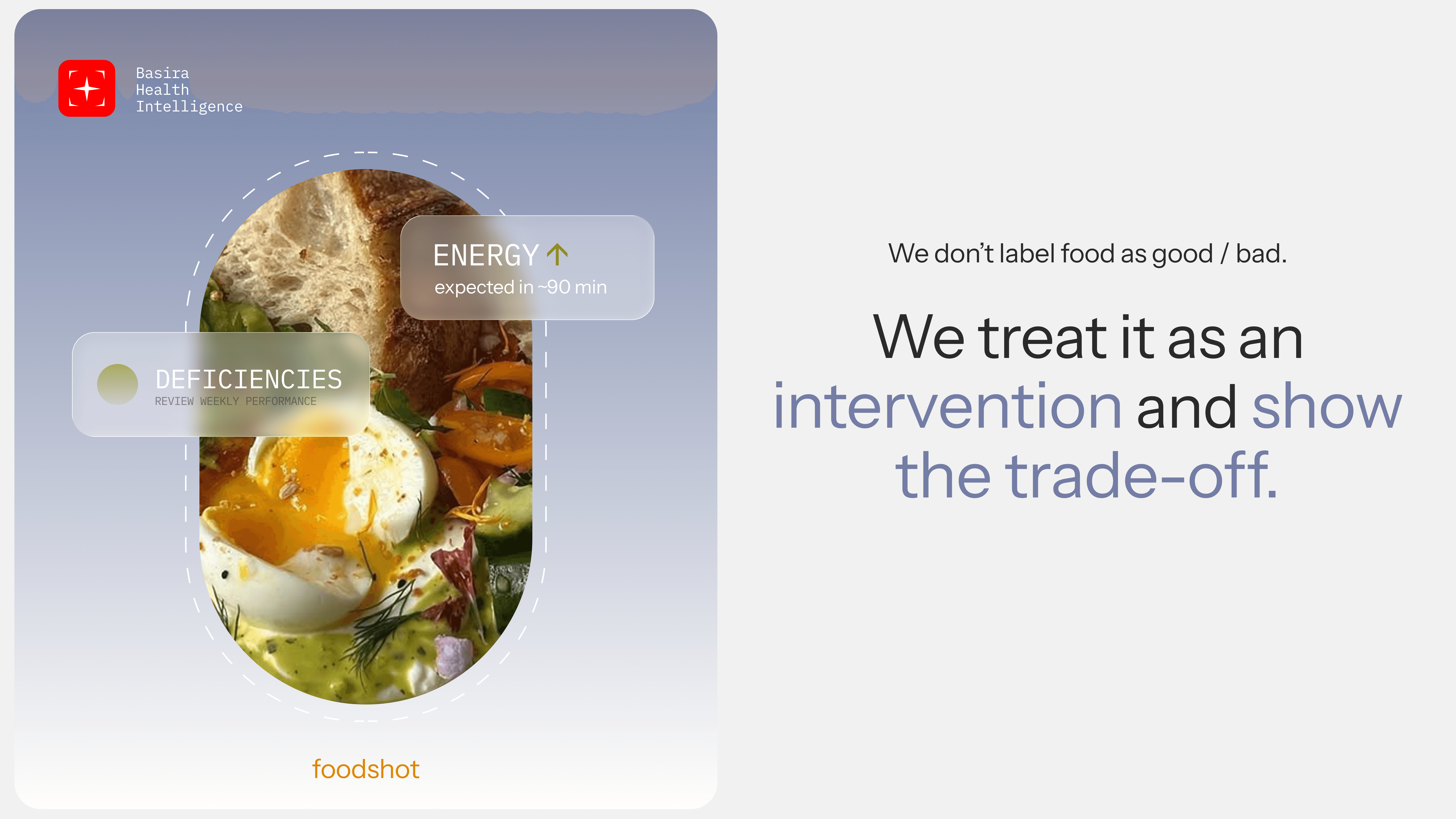
The moralization problem
Treating food as a moral issue creates two problems.
First, it makes feedback emotional instead of informational. When you eat something "bad," the response is guilt. Guilt doesn't help you understand what actually happened in your body. It just makes you feel worse.
Second, it obscures the actual trade-offs.
Food decisions are not about being good or bad. They're about biological trade-offs with different costs and benefits depending on context.
Eating carbs before bed might:
Help you sleep if cortisol is elevated
Disrupt sleep if insulin sensitivity is already low
Have zero effect if you're glycogen-depleted from training
The same food. Three different outcomes. None of them moral.
What "intervention" actually means
An intervention is just an input with a predicted output.
You take ibuprofen → inflammation decreases, pain reduces, but gastric irritation risk increases.
You drink coffee → adenosine blocked, alertness rises, but cortisol spikes and sleep pressure delays.
You eat protein → amino acids available, muscle protein synthesis supported, but digestive load increases.
Food works the same way. It's chemistry.
When you eat:
Macros → metabolic response
Fiber → gut transit and satiety
Polyphenols → inflammatory markers
Timing → circadian alignment
Volume → gastric stretch and hormone release
list goes on…
These are mechanisms, not morals.
Context determines outcome
Here's why the moral frame fails so badly: it treats food as if effects are fixed.
"Sugar is bad." "Vegetables are good."
But biology doesn't work that way.
The same meal produces different responses depending on:
What you ate in the past 24 hours
Your current stress state
How you slept last night
Where you are in your hormonal cycle
Your recent training load
An apple after a workout? Replenishes glycogen, supports recovery.
The same apple on an empty stomach after poor sleep? Might spike glucose, trigger reactive hypoglycemia, crash your energy by noon.
Biology is conditional. The intervention that works Monday fails Friday. Not because you "messed up," but because the biological context changed.
About Trade-offs
Once you drop the moral frame, food decisions become much clearer.
Not "should I eat this?" but "what happens if I do?"
You're considering ice cream after dinner. The question isn't whether you've "earned it" or whether it's "allowed"
The question is: what's the trade-off?
If you're insulin sensitive, slept well, and want hedonic satisfaction → minimal metabolic cost, high enjoyment. Could be worth it.
If you're already in sleep debt, stressed, and ate dessert yesterday → glucose dysregulation, poor sleep, compounded recovery deficit. Probably not worth it right now.
Same food. Different context. Different trade-off.
This isn't restriction. It's information.
Why prediction matters here
The moral frame can't do this. It just gives you rules, without actual reasoning.
"Don't eat sugar" Okay, but why? And does that mean never? Or just sometimes? And how do I know which times?
Prediction can:
"Given your current insulin sensitivity and recent eating pattern, this will likely cause a glucose spike followed by an energy crash around 3pm and disrupt your sleep onset tonight"…
Now you know the trade-off. You can decide if it's worth it.
Maybe it is. Maybe the social value of sharing dessert with friends outweighs the metabolic cost. That's a legitimate choice.
But it's an informed choice, not a moral failing.
The guilt-learning disconnect
Here's the strange thing about moralizing food that i hate: it actively prevents learning.
When you eat something and feel guilty, the feedback loop is: "I was bad" → shame → vague resolution to "do better"
But you don't learn what actually happened. You don't know if it disrupted your sleep, spiked your glucose, triggered inflammation, or did nothing at all!
Without biological feedback, you can't calibrate. You just repeat the cycle: restriction → guilt → confusion.
Reframe it as an intervention:
"I ate X"
→ "here's what happened biologically"
→ "this is what that cost me"
→ "now I know the trade-off for next time"
That's actual learning.
Beyond clean eating
The "clean eating" movement tried to solve the moralization problem by redefining what counts as "good."
But it's the same frame. Just different foods in the good/bad buckets.
Kale is virtuous. Bread is sinful. Quinoa is pure. Pasta is corrupt.
This doesn't fix anything. It just shifts which foods carry moral weight.
The way out isn't better rules. It's dropping the moral frame entirely. Food is not a test of your character, it's a simple biological input with measurable effects that vary by the context. You wouldn't feel guilty about taking aspirin, right? You'd evaluate: does this help right now, given what's happening in my body?
Food deserves the same treatment.
What this looks like in practice
Scenario: You want chocolate.
Moral frame: "I shouldn't. I've been bad this week. But I worked hard today, maybe I earned it? No, I need to have discipline. Okay just a small piece. Wait, I already messed up, might as well finish it."
Intervention frame: "I want chocolate. What's the probable outcome if I eat it right now? I slept poorly, already had sugar today, feeling stressed. Likely: glucose spike, energy crash, worse sleep tonight. That compounds existing deficit. Not worth the trade-off right now. Tomorrow after training, different story."
One spirals into guilt. The other makes a clear decision and moves on.
My last question here
The shift from morality to mechanism changes everything.
Not "am I good or bad?" but "what state am I in, and what will this intervention do?"
Not "do I have enough discipline?" but "is this trade-off worth it right now?"
Not "did I fail?" but "what did I learn about how my biology responds?"
Your body is not a moral system. It's a biological system :) It responds to inputs with outputs. Some outputs support your goals. Some don't. The outputs change based on context.
That's it. Honestly, no guilt required
Lets say like that, when you eat something, you're not being good or bad. You're running an experiment.
The only question is: did you get the data?