

Most health tracking assumes your body is the same every day.
It honestly is not built for cyclical biology.
And for half of the planet, women, this isn't a minor oversight. It's a fundamental architecture mismatch.
The static model problem
Current health systems are built on a simple assumption: measure baseline, track deviation, optimize toward stability.
This works fine if your biology is linear.
But women's biology isn't linear. It's cyclical.
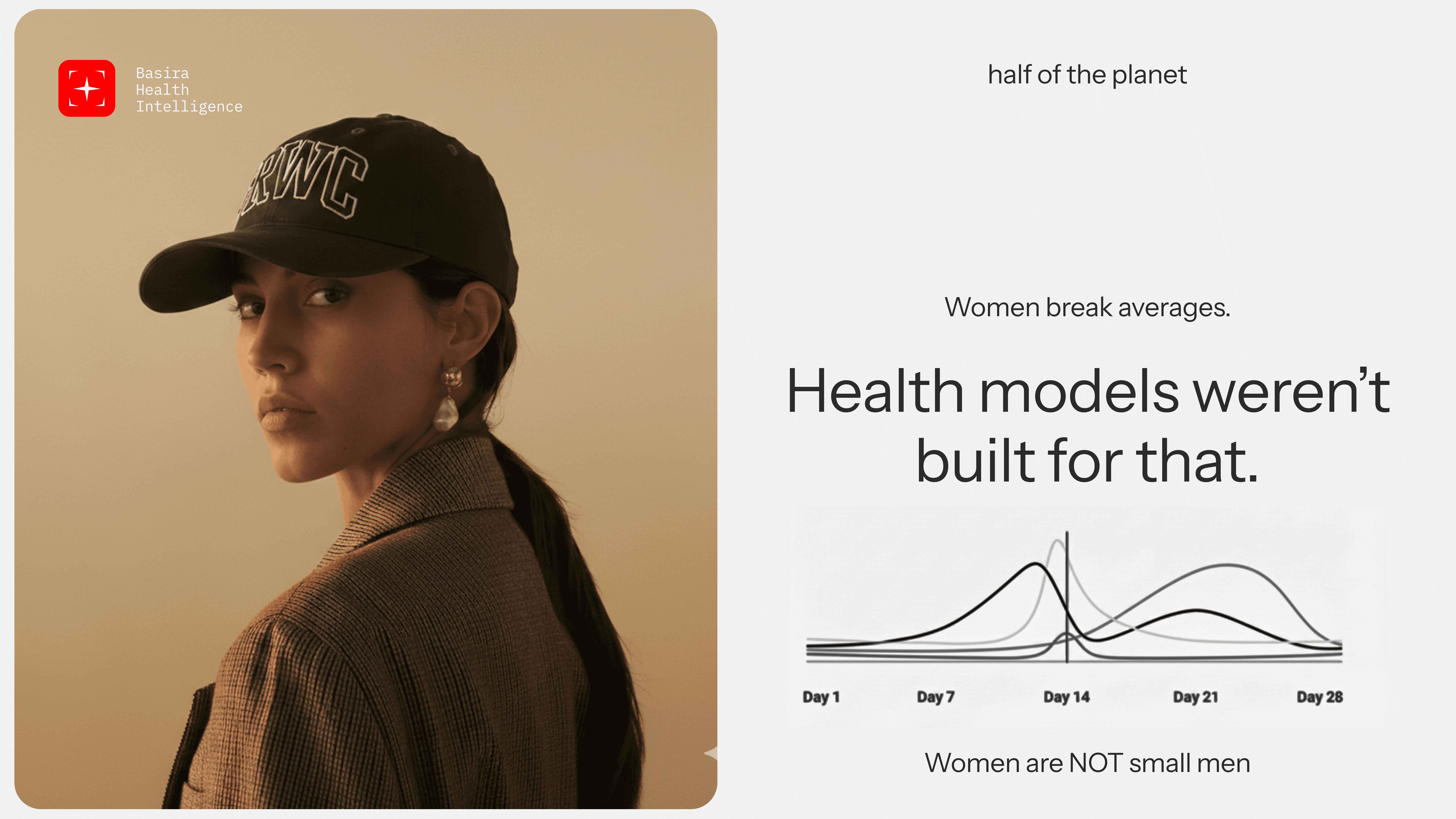
Hormone levels don't stabilize, they oscillate. Insulin sensitivity doesn't stay constant, it shifts across the cycle. Energy availability doesn't plateau, it waves.
The same workout that builds strength on day 7 causes excessive fatigue on day 24. The same meal that stabilizes energy on day 12 triggers inflammation on day 26.
Static models can't see this. They just see "inconsistency" and flag it as a problem to fix.
Cyclical systems need different infrastructure
But you can't track a cycle the way you track a stable state. You need:
Phase detection, not daily snapshots.
Where are you in the cycle? What's supposed to happen here?
Phase-specific ranges, not fixed targets.
What's normal for day 3 is abnormal for day 21.
Trajectory modeling, not point-in-time optimization.
How is this cycle progressing compared to your pattern?
This isn't an add-on feature. TBH it's an entirely different data model…
Why "track your period" isn't enough
Period tracking apps do one thing: predict when you'll bleed.
That's useful, fair. But it's not health modeling.
The menstrual cycle affects everything:
Metabolic flexibility (insulin sensitivity swings 30-40%)
Temperature regulation (core temp shifts up to 1°F)
Inflammation response (varies by phase)
Sleep architecture (changes across the cycle)
Training adaptation (muscle protein synthesis fluctuates)
Cognitive function (working memory and focus shift)
and these aren't minor variations... They're the difference between "this intervention works" and "this intervention backfires."
Knowing when your period arrives doesn't help you navigate any of this
The prediction gap
Here's what women actually need:
Not "your period starts in 5 days."
But something like "you're entering the luteal phase. Insulin sensitivity is dropping. High-carb meals will likely cause energy crashes for the next 10 days. Protein timing becomes more important. Sleep disruption risk increases."
Not "you're ovulating."
But "you're in the follicular window. Training adaptation is highest right now. Your body can handle more load. Recovery will be faster. This is the week to push."
The difference is: one tells you what's happening. The other tells you what to do about it.
Why this matters beyond periods
This isn't just about menstruation.
It's about any cyclical system:
Perimenopause (irregular but still patterned)
Postpartum (recovering, not stable)
PCOS (disrupted cycles still have rhythm)
Post-birth control (re-establishing patterns)
All of these require models that understand oscillation
Static models pathologize variation that's actually normal. They try to "fix" patterns that don't need fixing.
What women's health tech should do
Context transforms data from confusing to clarifying.
Beyond gender
Interestingly, this model works better for everyone.
Men have cycles too … circadian rhythms, training cycles, stress accumulation patterns.
But these are optional overlays for men's health. For women, cycle-awareness is foundational.
You can build decent men's health tech without modeling cycles.
You cannot build functional women's health tech without it.
Women don't need pink apps or softer language or more encouragement.
They need health systems that understand their biology operates in waves
They need models that predict how interventions land in different phases
They need infrastructure built for oscillation, not stability
BHI
Building health systems that understand cycles